
Introduction
Customer support teams often handle the same questions repeatedly while also dealing with complex issues that require human attention. An AI agent for customer support can help by understanding customer requests, providing answers, finding information, and completing selected support tasks.
Unlike a basic chatbot that follows a fixed set of responses, an AI customer service agent can use artificial intelligence to interpret conversations and determine what action may be appropriate.
In this guide, you will learn how AI support agents work, what they can do, their benefits and limitations, common use cases, and how businesses can introduce them into a customer service workflow.
What Is an AI Agent for Customer Support?
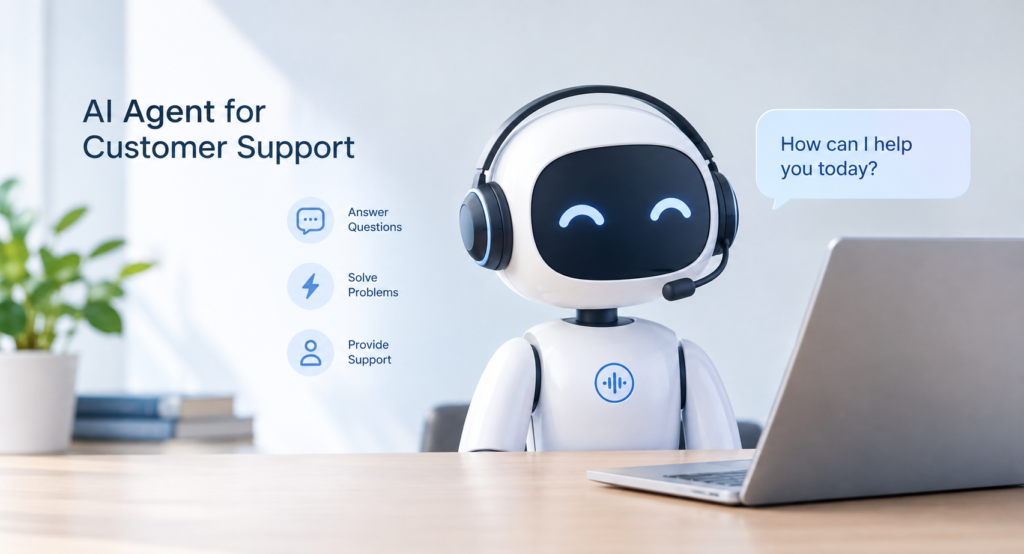
An AI agent for customer support is an AI-powered system designed to interact with customers and assist with service-related requests.
It can communicate through channels such as a website chat widget, messaging platform, or customer support portal. Depending on its integrations and permissions, the agent may answer questions, search a knowledge base, collect information, update records, or escalate an issue to a human representative.
The goal is not simply to automate conversations. A well-designed AI support agent connects customer questions with relevant information and business processes.
AI Agent vs Traditional Chatbot
Traditional chatbots often depend on predefined rules, menus, keywords, or decision trees.
An AI agent can use natural language processing and large language models to understand more flexible customer requests. It may also connect with business systems to retrieve information or trigger specific workflows.
However, capabilities vary considerably between AI platforms. Businesses should evaluate each system based on its actual integrations, permissions, accuracy, and safeguards.
How Does an AI Customer Support Agent Work?
The workflow usually begins when a customer sends a question.
The AI analyzes the request, identifies relevant information, and generates a response. If the system has access to approved business tools, it may also retrieve account information or perform an authorized action.
A simplified process looks like this:
- Customer sends a request.
- AI interprets the customer’s intent.
- The system searches approved information sources.
- The agent generates an appropriate response.
- A supported action may be completed.
- Complex issues can be transferred to a human agent.
This combination of conversation, information retrieval, and workflow automation is what makes an AI agent different from a simple FAQ bot.
What Can an AI Support Agent Do?
The exact capabilities depend on the tools and permissions connected to the agent.
Answer Frequently Asked Questions
AI agents can respond to common questions about:
- Products and services
- Pricing information
- Account processes
- Shipping policies
- Returns and refunds
- Business hours
- Product features
- Basic troubleshooting
A well-maintained knowledge base gives the agent reliable information to work with.
Provide 24/7 Customer Assistance
An AI customer service agent can respond outside normal business hours.
This can help customers find basic information without waiting for a support representative to become available.
It also allows human teams to focus on requests that genuinely require their attention.
Handle Basic Troubleshooting
AI can guide customers through structured troubleshooting steps.
For example, a support agent could explain how to reset a password, configure a setting, locate a feature, or resolve a common software issue.
More complicated technical problems can be escalated when the AI reaches the limits of its available information.
Collect Customer Information
Before transferring a conversation to a human representative, an AI agent can collect relevant details.
This might include:
- Customer name
- Order information
- Product details
- Problem description
- Error messages
- Previous troubleshooting steps
This information can help the human support representative understand the issue without asking the customer to repeat everything.
Route Support Requests
An AI agent can categorize incoming requests and direct them to the appropriate workflow or department.
For example, billing questions may follow a different process from technical support requests.
Effective routing can help organize support operations and reduce unnecessary transfers.
What Are the Benefits of AI Agents for Customer Support?
AI-powered support can provide several operational benefits when implemented carefully.
Faster Responses
AI can respond to supported requests immediately rather than requiring a customer to wait for a representative.
This can make the first stage of customer service more responsive.
Reduced Repetitive Work
Support employees often answer similar questions many times.
An AI agent can handle appropriate repetitive requests while human employees concentrate on complex cases, relationship-building, and problems requiring judgment.
More Consistent Information
An AI agent connected to an approved knowledge base can provide standardized answers based on the information available to it.
Businesses should still monitor responses and update their source material when policies, products, or processes change.
Better Support Scalability
As customer inquiries increase, businesses may need additional support capacity.
AI can provide an additional layer of assistance without requiring every basic interaction to be handled manually.
Improved Agent Handoffs
A useful AI system should not try to handle every problem.
When human assistance is required, the system can transfer the conversation along with relevant context, depending on the available support software and integrations.
AI Agent for Customer Support Use Cases
AI support agents can be applied across different industries and business models.
E-Commerce Customer Service
Online stores can use AI to answer questions about orders, shipping, returns, product information, and store policies.
For account-specific requests, the agent may need secure access to appropriate commerce or customer relationship management systems.
SaaS Customer Support
Software companies can use AI agents to help customers understand product features, troubleshoot common issues, and find documentation.
An AI agent can also direct users toward relevant help articles or product resources.
Financial Services Support
AI can assist with general questions about services, procedures, and documentation.
Because financial information can be sensitive, businesses in this sector need strong security, privacy controls, authorization rules, and human escalation processes.
Healthcare Support
AI may assist with administrative customer service tasks such as appointment information, general service questions, or navigation of approved resources.
Sensitive healthcare matters require appropriate safeguards and should not be handled as if an AI system were a substitute for qualified professionals.
How to Build an AI Agent for Customer Support
A successful implementation starts with a clearly defined scope.
Step 1: Identify Repetitive Requests
Review your existing support conversations and identify questions that are frequent, structured, and suitable for automation.
Do not start by trying to automate every support interaction.
Step 2: Prepare a Reliable Knowledge Base
Give the AI access to accurate and relevant information.
Your knowledge base might include:
- Help center articles
- Product documentation
- Return policies
- FAQs
- Troubleshooting guides
- Internal support procedures
Outdated documentation can lead to outdated answers.
Step 3: Define Permissions
Determine exactly what the AI can access and what actions it can perform.
Use the principle of giving the agent only the permissions it needs for its assigned tasks.
Step 4: Create Escalation Rules
Define situations that require human assistance.
Examples can include:
- Sensitive account issues
- Complaints
- Complex technical problems
- Requests outside the agent’s knowledge
- High-risk transactions
- Situations requiring human judgment
Step 5: Test Before Deployment
Test the agent with realistic customer questions.
Look for incorrect answers, unclear responses, poor escalation behavior, and situations where the AI lacks enough information.
How to Make AI Customer Support More Effective
AI quality depends on more than the underlying model.
Businesses should maintain accurate documentation, monitor conversations, improve prompts and workflows, and review failed interactions.
It is also useful to give customers a clear way to request human assistance. Customers should not become trapped in an automated conversation when their issue requires a person.
Regular testing can reveal new questions that should be added to the knowledge base.
Limitations of AI Customer Service Agents
AI agents can be useful, but they have important limitations.
They Can Make Mistakes
AI systems can generate incorrect or misleading responses.
For that reason, businesses should use reliable information sources, establish safeguards, and monitor important interactions.
They May Struggle With Unusual Requests
A customer may describe an unusual problem that was not covered during testing.
A good system should recognize uncertainty rather than confidently inventing an answer.
Complex Problems Still Need Humans
Some customer issues involve emotion, negotiation, exceptions, or business judgment.
Human representatives remain important for these situations.
Integration Can Be Challenging
An AI agent becomes more useful when it can work with relevant business systems, but integrations require careful planning.
Access controls, data security, authentication, and workflow reliability all matter.
AI Agent vs AI Chatbot: What’s the Difference?
An AI chatbot is primarily focused on conversation.
An AI agent can go further by interpreting a request, retrieving relevant information, deciding which supported workflow to use, and potentially taking an authorized action.
The distinction is not always absolute because different vendors use these terms differently. The most useful way to evaluate a product is to examine what it can actually do rather than relying only on its label.
Frequently Asked Questions
What is an AI agent for customer support?
An AI agent for customer support is an AI-powered system that can understand customer requests, provide information, assist with troubleshooting, and perform selected support workflows.
Can AI agents replace customer support agents?
AI can automate some support tasks, but many situations still require human representatives. A hybrid approach can allow AI to handle suitable routine requests while people manage complex or sensitive cases.
What is the difference between an AI agent and a chatbot?
A chatbot primarily focuses on conversation, while an AI agent can potentially use tools, retrieve information, and complete authorized actions as part of a support workflow.
How do I train an AI customer support agent?
Start by providing accurate business documentation and defining the tasks, permissions, escalation rules, and response guidelines the agent should follow. Test it with realistic support scenarios before deployment.
Is AI customer support secure?
Security depends on the platform, integrations, configuration, data handling, and access controls. Businesses should evaluate authentication, permissions, privacy practices, data retention, and compliance requirements before deployment.
Final Thoughts
An AI agent for customer support can help businesses automate repetitive requests, provide faster assistance, organize incoming conversations, and give human support teams more time for complex problems.
The strongest implementation is not necessarily the one that automates the most tasks. Instead, businesses should define a practical scope, connect reliable information sources, control permissions, and provide clear human escalation.
If you are considering AI customer service, start with a small group of repetitive support requests. Test the workflow, review the results, and expand the agent’s responsibilities as your team gains confidence.
Ready to improve your support workflow? Identify your most repetitive customer questions and explore how an AI agent can handle them while your team focuses on higher-value conversations.