
Best AI Governance Compliance Tools for Workflow Management in 2026. Discover the best AI governance compliance tools for workflow management in 2026. Compare top platforms like Credo AI, IBM Watsonx, OneTrust, and more to stay compliant and reduce AI risk. AI governance compliance tools. Enterprise AI / Compliance / GRC.
Introduction
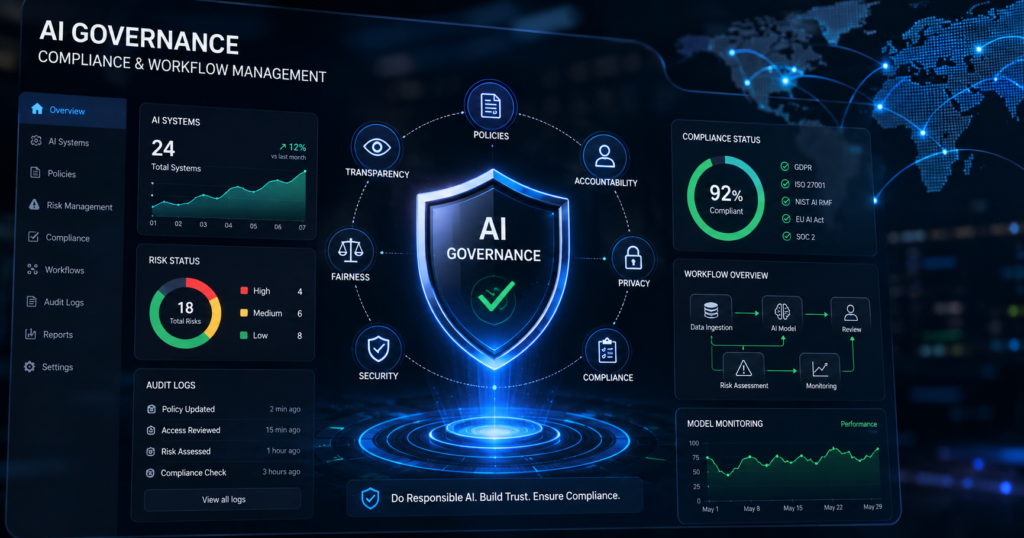
Artificial intelligence is no longer a future technology — it is a present operational reality. Enterprises across every sector are deploying AI systems to automate decisions, analyze data, and accelerate workflows at a scale that was unimaginable just five years ago. But with that scale comes a serious and growing problem: how do you govern it responsibly?
AI governance has evolved from aspirational principles to operational necessity as organizations deploy AI systems at scale. Left ungoverned, AI systems drift, produce biased outputs, create undocumented decisions, and expose organizations to enormous regulatory and reputational risk. Maxim Articles
In 2026, this is no longer a theoretical concern. With the EU AI Act’s high-risk enforcement deadline arriving in August 2026 and enterprises scaling AI deployments across every business function, the question is no longer whether you need an AI governance platform — it’s which one. Difinity
A recent study suggests that the AI governance industry is growing significantly faster than the AI industry itself, clocking a CAGR of 45.3% from 2024 to 2029. And Gartner predicts that 60% of organizations will fail to realize AI value due to weak governance. SplunkDancumberlandlabs
This guide covers the best AI governance compliance tools for workflow management in 2026 — what they do, who they’re built for, and how to choose the right one for your organization.
Table of Contents
- Why AI Governance Compliance Matters in 2026
- What to Look for in an AI Governance Tool
- The 7 Best AI Governance Compliance Tools
- Side-by-Side Comparison
- How to Choose the Right Tool
- Conclusion
Why AI Governance Compliance Matters in 2026
The pressure on organizations to govern their AI systems is coming from multiple directions simultaneously — regulatory, operational, and reputational. On the regulatory side, the EU AI Act imposes mandatory compliance requirements on AI systems used in high-risk domains, including employment, credit, healthcare, and critical infrastructure. Non-compliance carries fines that rival GDPR penalties. In the United States, frameworks like the NIST AI Risk Management Framework (AI RMF) and ISO 42001 are rapidly becoming industry baselines expected by enterprise procurement teams, insurers, and board-level audit committees. On the operational side, AI systems degrade over time. Models drift. Training data becomes stale. Edge cases multiply. Without continuous monitoring and governance controls, what worked at deployment will quietly fail in production — often without anyone noticing until real harm has occurred. On the reputational side, AI failures are increasingly public. A biased hiring algorithm, a discriminatory lending model, or a hallucinating customer-facing AI tool can generate headlines that take years to recover from. To navigate this landscape, companies are turning to AI compliance tools. These platforms serve a dual purpose: they use artificial intelligence to automate traditional compliance workflows, and they provide the governance infrastructure needed to ensure your own AI systems are safe, ethical, and legally compliant. The AI Journal, The organizations that invest in proper governance infrastructure now will have a measurable compliance and competitive advantage over those that wait.
What to Look for in an AI Governance Tool
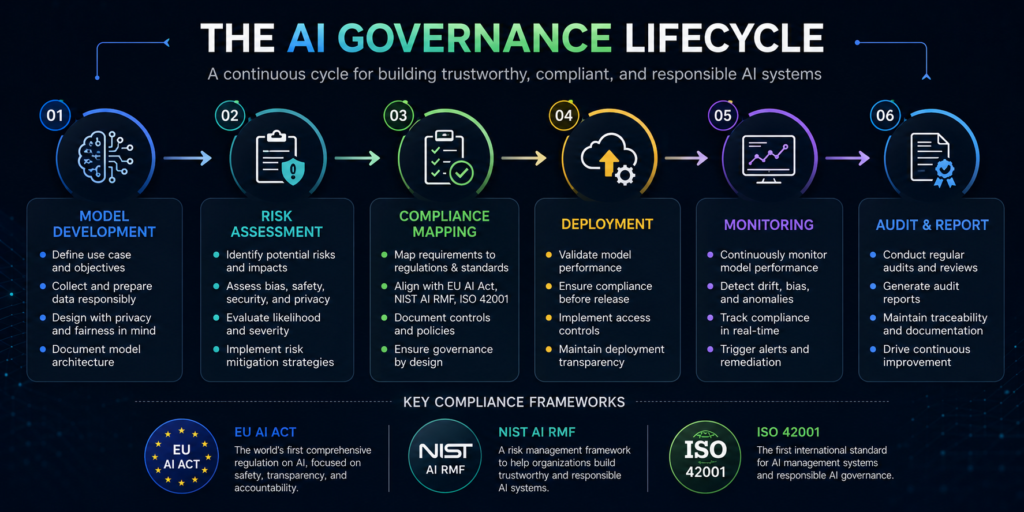
AI governance tools offer a wide array of features, including compliance and reporting, data governance, human oversight, and end-to-end explainability, among others. These features ensure greater transparency, accountability, and trust in the AI systems an organization uses. Atlan
Before diving into specific platforms, here are the six capabilities that matter most for workflow management:
1. AI Model Registry and Usage Catalog A centralized inventory of every AI model, agent, and tool deployed across the organization. This tracks versions, ownership, risk classifications, and approval status — making it possible to answer the fundamental governance question: “What AI are we actually running, and who approved it?”
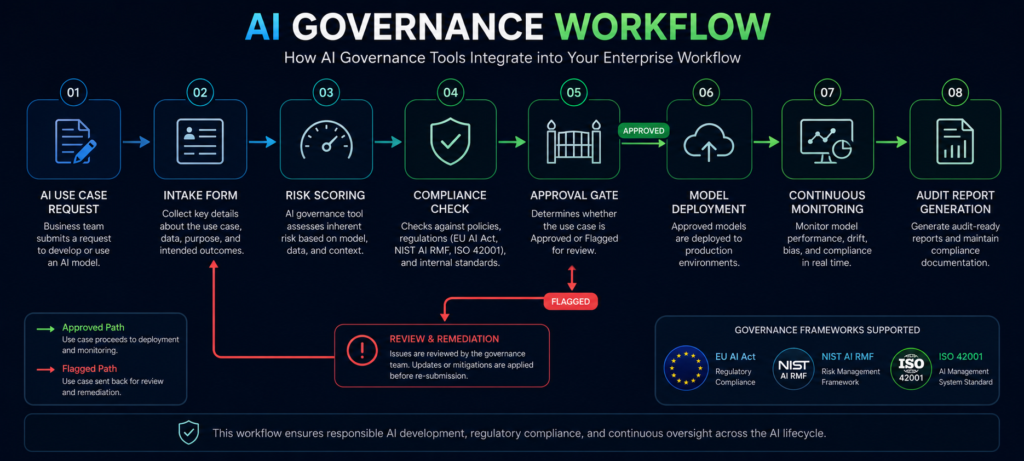
2. Workflow Automation Automated intake reviews, risk assessments, and approval workflows that replace manual, email-based processes. The best platforms turn governance from a bottleneck into a streamlined pipeline that accelerates responsible deployment rather than slowing it down.
3. Regulatory Framework Mapping Built-in compliance mappings to the EU AI Act, NIST AI RMF, and General Data Protection Regulation, as well as ISO 42001, Colorado SB 205, and industry-specific requirements. The platform should automatically connect your AI systems to the regulations that apply to them. Teramind
4. Risk Scoring and Assessment Automated, attributes-based risk scoring that evaluates each AI system and recommends appropriate governance actions. This removes guesswork from risk prioritization and ensures that high-risk systems get the scrutiny they require.
5. Audit Trails Audit trails that record governance decisions and policy assessments for regulatory reporting. These records must be immutable, timestamped, and detailed enough to satisfy both internal audit teams and external regulators. Teramind
6. Integrations Native connectors to your existing ML platforms (AWS SageMaker, Azure ML, Google Vertex), data catalogs, and GRC systems. Governance tools that exist in isolation create more work — the best ones embed seamlessly into the workflows your teams already use.
The 7 Best AI Governance Compliance Tools for Workflow Management in 2026
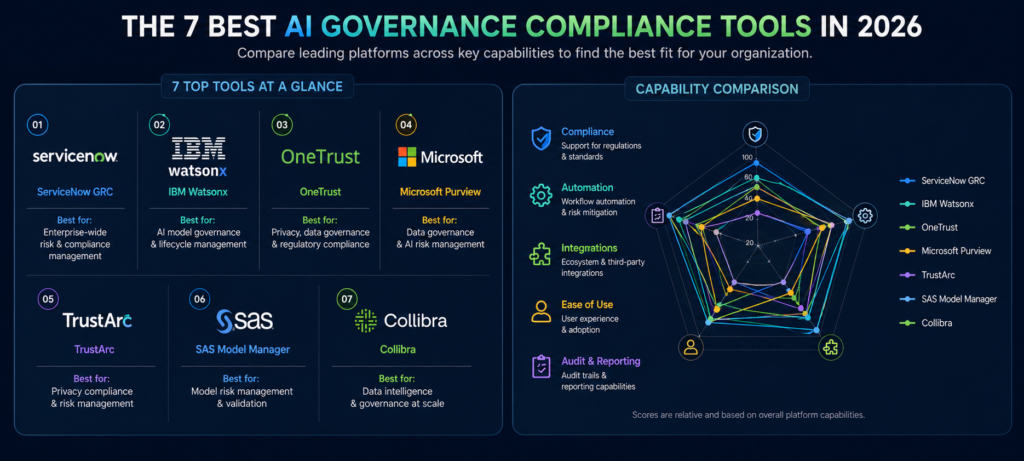
The AI governance market in 2026 centers on leading platforms — each with a distinct approach ranging from compliance-first GRC extensions to purpose-built AI governance platforms. Here are the seven best. Dancumberlandlabs
1. Credo AI — Best for Lifecycle Compliance and Policy Automation
Credo AI is the most purpose-built AI governance platform available today. It’s purpose-built for AI governance — not a privacy platform with AI governance bolted on. The platform was designed from the ground up to translate complex regulatory requirements into operational controls that compliance, legal, and product teams can actually use in their day-to-day workflows. Dancumberlandlabs
Credo AI functions as an intelligence layer that integrates with your AI systems, converting technical documentation into practical insights regarding risk and compliance for product managers, data scientists, and governance professionals. Slashdot
One of its most forward-looking features is its Agent Registry, which tracks agentic AI capabilities and autonomy levels — a critical capability as organizations increasingly deploy autonomous AI systems that make consequential decisions without human review at each step.
Key Features:
- Automated policy enforcement mapped to EU AI Act, NIST AI RMF, ISO 42001, GDPR, and Colorado SB 205
- AI inventory management that registers and tracks AI tools and models across the organization Teramind
- Compliance scoring that evaluates each AI initiative against applicable regulatory requirements Teramind
- End-to-end dashboards tracking AI risk, compliance status, and asset value
- Comprehensive audit trails for regulatory reporting
Best For: Compliance-focused enterprises that need a governance platform capable of managing policy and regulatory alignment across many AI systems simultaneously — particularly legal, risk, and compliance teams that need structured oversight without getting into the technical weeds of model risk management. Teramind
2. IBM Watsonx.governance — Best for Enterprise Risk Management in IBM Ecosystems
For organizations already invested in the IBM technology stack, Watsonx.governance delivers the deepest and most integrated AI governance experience available. IBM Watsonx.governance is an enterprise-grade AI governance solution designed to manage risk and ensure compliance across the full AI lifecycle. It enables organizations to monitor, govern, and manage any AI system — whether models, applications, or agents — across IBM technologies as well as third-party platforms such as OpenAI, AWS, and Meta. Gartner
IBM Watsonx.governance focuses on structured AI risk management and compliance workflows. It emphasizes documentation, governance processes, and lifecycle controls. Its Guardium AI security module adds a layer of protection that most standalone governance tools cannot match. Ovaledge
Key Features:
- Lifecycle, risk, security, and compliance governance built on the watsonx.data open data lakehouse
- Proactive detection and mitigation of AI risks, with evaluation of AI assets and secure AI deployments through Guardium AI security Gartner
- Support for safe and transparent AI adoption with a robust regulatory library
- Model monitoring, drift detection, and performance tracking
- Deep integration with Watson Studio, IBM Cloud, and OpenPages
Best For: Organizations that need lifecycle governance for traditional ML and generative AI within an IBM-centric stack. Maxim Articles.
3. OneTrust AI Governance — Best for GRC-Integrated Compliance in Regulated Industries
OneTrust is the established gold standard for enterprise data privacy compliance, and its AI Governance module is the natural and powerful extension for organizations already running their privacy programs on the platform. OneTrust provides the tightest integration with existing privacy compliance workflows for organizations that need unified data privacy and AI governance under a single platform. Maxim Articles
OneTrust AI Governance provides an AI asset inventory with a focus on operationalizing frameworks and standards, while also ensuring the simplification of compliance using automated discovery, asset mapping, and regulatory framework tracking. Atlan
Its strength in heavily regulated industries — financial services, healthcare, insurance, and government — comes from years of building compliance workflows that satisfy external auditors, not just internal risk teams.
Key Features:
- AI asset inventory with automated discovery and asset mapping
- Regulatory framework tracking spanning EU AI Act, CCPA, GDPR, and sector-specific requirements
- Tight integration with existing OneTrust privacy compliance programs
- Risk and impact assessment templates for rapid deployment
- Vendor AI risk management for third-party AI tool governance
Best For: Organizations already using OneTrust for privacy compliance, or those in regulated industries needing unified data privacy and AI governance in one platform.
4. Bifrost by Maxim AI — Best for Infrastructure-Level Gateway Governance
Bifrost takes a fundamentally different approach from every other tool on this list. Rather than managing compliance documentation after models are deployed, Bifrost operates at the infrastructure layer where every AI request is processed, making it the enforcement point that other governance tools build upon. Bifrost’s AI governance tools enforce access control, cost management, and compliance at the gateway layer with 11 microseconds of overhead. Maxim Articles
Bifrost by Maxim AI leads with infrastructure-level governance through budget controls, access management, and audit logging, integrated with Maxim’s comprehensive quality evaluation and observability platform. Maxim Articles
This makes Bifrost an ideal foundation to pair with a lifecycle governance tool — it handles real-time enforcement while platforms like Credo AI handle documentation and regulatory compliance.
Key Features:
- Infrastructure-level governance enforced at the AI gateway layer
- Budget controls and cost management per team, model, or use case
- Access management defining who can use which models and agent tools
- Comprehensive audit logging of every AI request processed
- Integration with Maxim’s quality evaluation and observability platform
- Only 11 microseconds of added latency — negligible performance impact
Best For: Engineering and platform teams that need real-time enforcement of governance policies at the infrastructure level, particularly organizations managing multiple AI models across multiple teams.
5. Holistic AI — Best for Algorithmic Fairness and Bias Auditing
Holistic AI’s platform is purpose-built for organizations that need to prove their AI is fair — not just compliant. Holistic AI is an AI governance platform that delivers end-to-end AI lifecycle management, from ideation to post-deployment. Its goal is to ensure that every stage impacts your business’s value. Splunk
Its particular strength is in algorithmic bias auditing for employment or lending AI systems, with specialized fairness assessment tools that go far deeper than the surface-level fairness checks available in general-purpose governance platforms. For organizations deploying AI in domains where discriminatory outcomes carry legal liability, Holistic AI provides the specialized rigor that regulators and auditors expect. Maxim Articles
Key Features:
- End-to-end AI lifecycle management from ideation through post-deployment monitoring
- Specialized fairness assessment and algorithmic bias auditing for high-stakes domains
- Compliance support for EU AI Act, UK AI regulations, and global frameworks
- Risk scoring with actionable remediation recommendations
- Vendor AI risk assessments for third-party model governance
- Designed for collaboration across technical and non-technical teams
Best For: Organizations in employment, lending, healthcare, and insurance deploying AI in high-risk domains where fairness auditing is a legal or regulatory requirement.
6. Trustible — Best for Scaling AI Governance Across the Enterprise
Trustible is a purpose-built AI governance platform that helps organizations introduce, assess, and oversee AI across the enterprise. The platform orchestrates AI use case intake, risk and impact assessments, regulatory compliance, vendor and model evaluations, and policy management. Gartner
Trustible’s particular strength is accessibility. It is designed to scale governance programs without requiring a dedicated team of AI experts — making it ideal for organizations where the people responsible for AI oversight are the same people responsible for IT, legal, and operations. Its AI-assisted vendor documentation analysis is a standout workflow feature, automatically extracting and assessing governance-relevant information from third-party AI vendor documents that would otherwise require hundreds of hours of manual review.
Key Features:
- Centralized AI Inventory, automated workflows for intake reviews and approvals, and an attributes-based risk scoring engine that recommends governance next steps Gartner
- Expert-curated taxonomies for AI risks and mitigations
- AI-assisted vendor documentation analysis
- Compliance mappings for more than ten regulatory frameworks including EU AI Act and NIST AI RMF
- Policy management and regulatory compliance tracking
Best For: Organizations scaling AI governance programs that need a platform usable by both legal/compliance and product teams, without requiring deep technical expertise.
7. Microsoft Azure AI (Responsible AI) — Best for Cloud-Native Governance in Azure Environments
For enterprises running AI workloads on Microsoft Azure, the platform’s responsible AI capabilities offer the most seamless governance integration available. Rather than adding a separate governance layer on top of existing workflows, Azure’s responsible AI tools are embedded directly into the model development and deployment pipeline — making governance a byproduct of building rather than a separate process. The platform covers the full responsible AI spectrum: fairness assessment, model interpretability, error analysis, privacy-preserving machine learning, content safety monitoring for generative AI, and compliance documentation — all natively integrated with Azure Machine Learning.
Key Features:
- Cloud-native governance embedded directly in Azure ML pipelines
- Responsible AI dashboard with fairness, explainability, and error analysis built in
- Azure Policy integration for automated compliance enforcement at the infrastructure level
- Content Safety API for monitoring and filtering generative AI outputs in production
- Model monitoring and drift detection for production deployments
- Enterprise-grade security, access controls, and detailed audit logging
Best For: Microsoft-centric organizations deploying AI on Azure that want governance capabilities embedded directly in their existing cloud infrastructure without adopting a separate platform.
Side-by-Side Comparison: AI Governance Compliance Tools
| Tool | Regulatory Mapping | Workflow Automation | Model Registry | Audit Trail | Best Use Case |
|---|---|---|---|---|---|
| Credo AI | 10+ frameworks | Full lifecycle | ✅ Yes | ✅ Yes | Policy-first compliance |
| IBM Watsonx | IBM + 3rd party | Lifecycle controls | ✅ Yes | ✅ Yes | IBM enterprise environments |
| OneTrust AI | Privacy + AI Acts | GRC workflows | ✅ Auto-discovery | ✅ Yes | Regulated industries |
| Bifrost / Maxim | Partial | Gateway-level | Partial | ✅ Full logging | Infrastructure enforcement |
| Holistic AI | Global frameworks | End-to-end | ✅ Yes | ✅ Yes | Fairness & bias auditing |
| Trustible | 10+ frameworks | Intake + approval | ✅ Yes | ✅ Yes | Scaling governance programs |
| Azure AI | Azure-native | Pipeline-embedded | ✅ Azure ML | ✅ Yes | Azure-first organization |
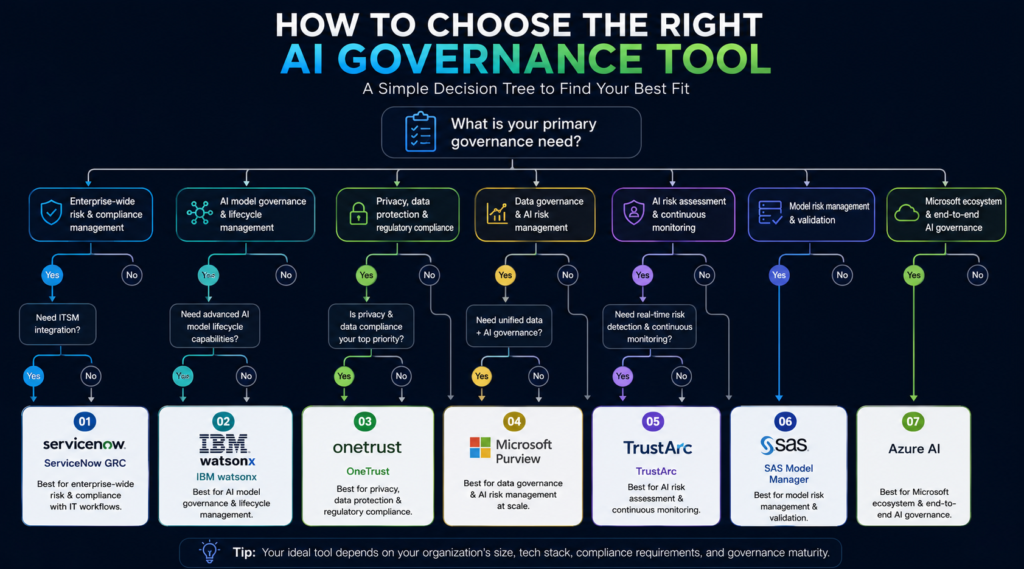
How to Choose the Right AI Governance Tool for Your Organization
The best governance platform is the one that matches how your organization already works — not the one with the longest feature list. Use these decision points to narrow down your shortlist: Dancumberlandlabs
If you already use OneTrust for privacy compliance → OneTrust AI Governance is the path of least resistance. The integration is seamless and avoids buying duplicate GRC infrastructure.
If you run AI in an IBM-centric technology stack → IBM Watsonx.governance provides the deepest native integration with the broadest coverage for both traditional machine learning and generative AI.
If your primary need is regulatory documentation and audit-ready reporting → Credo AI delivers the most comprehensive policy packs and audit-ready reporting. Maxim Articles
If you deploy AI in employment, lending, or healthcare → Holistic AI offers specialized fairness assessment tools that general-purpose platforms cannot replicate. Maxim Articles
If you are building entirely on Microsoft Azure → Azure’s responsible AI tools are already embedded in your deployment pipeline, making them the most operationally efficient choice.
If you need real-time enforcement at the infrastructure level → Bifrost by Maxim AI is the only tool operating at the AI gateway layer, making it a strong foundation to pair with any lifecycle governance platform.
If you are starting a governance program from scratch → Trustible is the most accessible entry point, designed to scale without requiring dedicated AI governance expertise.
It is also worth noting that many organizations will need more than one tool. A common architecture pairs infrastructure-level governance with lifecycle governance — giving you both real-time enforcement and comprehensive compliance documentation working together. Maxim Articles
Conclusion
AI governance is no longer a compliance checkbox — it is a core operational function that determines whether organizations can deploy AI confidently, defend their systems to regulators, and maintain the trust of their customers and employees.
The seven platforms covered in this guide represent the best of what the market offers in 2026: purpose-built compliance automation, infrastructure-level enforcement, algorithmic fairness auditing, and enterprise-scale workflow management. Each one addresses a different dimension of the governance challenge, and the right choice depends entirely on your organization’s existing infrastructure, regulatory exposure, and governance maturity.
What is clear across all of them is the same underlying principle: the most effective governance strategies recognize that infrastructure controls, quality assurance, compliance documentation, and operational transparency are interconnected. Governance is not a single tool or a single team — it is an architecture that weaves accountability into every stage of how AI is built, deployed, and monitored. Maxim Articles
Start with your most pressing governance gap. Deploy the right platform for that need. Build from there.